Latest Post

Hiển thị các bài đăng có nhãn animal. Hiển thị tất cả bài đăng

Chủ Nhật, 13 tháng 11, 2016

The best collection of Gibbon facts

The best collection of Gibbon interesting facts:

Gibbon is a small ape. Its closest relatives are gorilla, chimpanzee, orangutan and bonobo. There are 15 species of gibbons that can be found in Southeast Asia (China, India, Burma, Malayan peninsula, Borneo…). Gibbon lives in dense jungles and tropical rainforests.

Gibbon facts
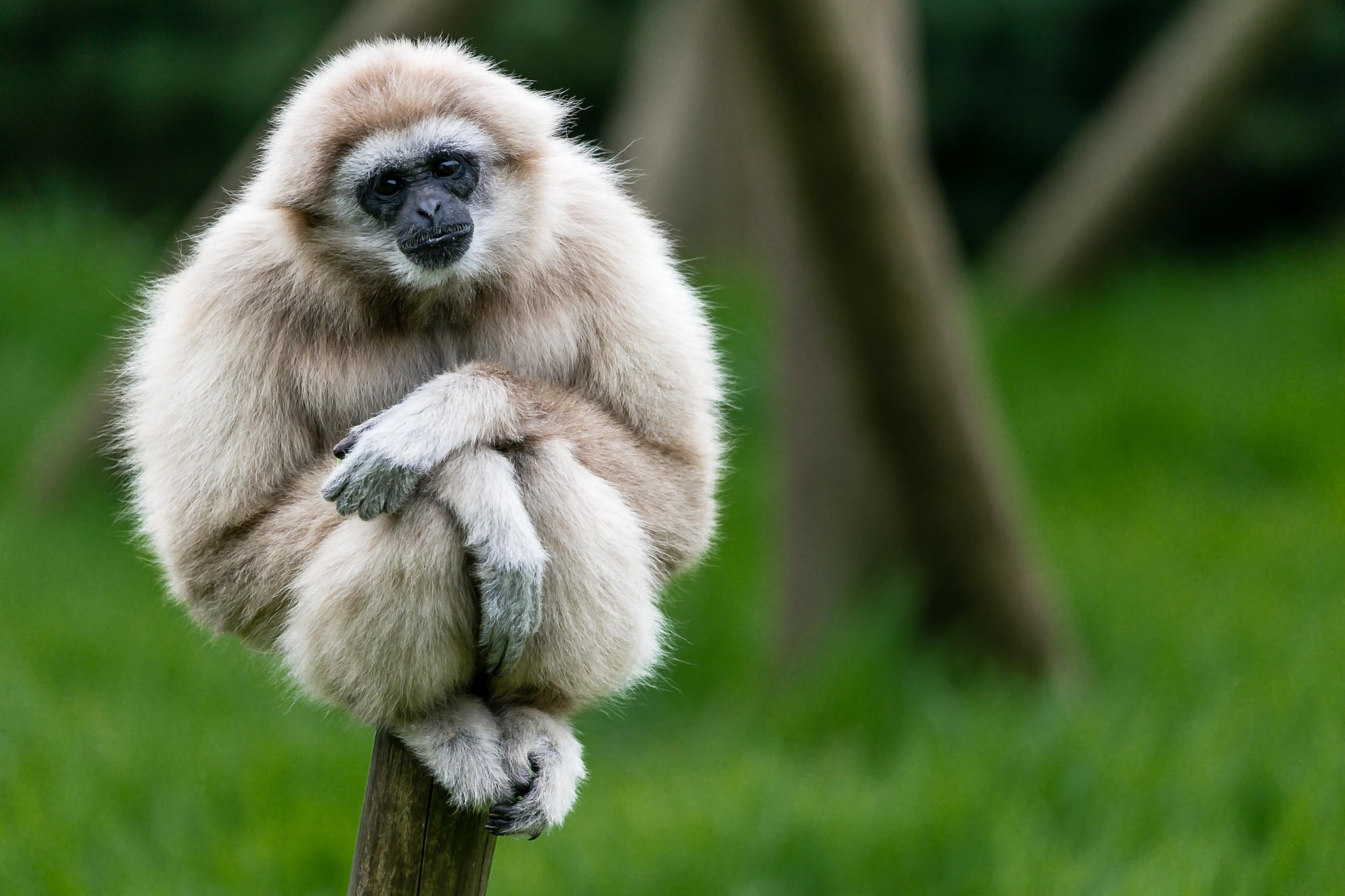
  • Gibbons spend almost all of their time in the treetops of the rainforest. They even sleep there, resting in the forks of branches.
  • Their dramatic form of locomotion, called brachiating, can move gibbons through the jungle at up to 35 miles (56 kilometers) an hour, bridging gaps as wide as 50 feet (15 metres) with a single swinging leap.
  • Because they are not able to swim, different types of gibbons are isolated in different areas by large rivers.
  • When gibbons walk, whether along branches or in the rare instances when they descend to the ground, they often do so on two feet, throwing their arms above their head for balance.
  • They are the most bipedal of all non-human primates and are often studied for clues to what evolutionary pressures may have led to human walking.
  • There are 15 recognized species of gibbons ranging from northeastern India to southern China to Borneo. Let’s discover some interesting science facts that will amaze you.
  • Gibbons are omnivores (they eat both plants and animals). Their diet consists mainly of fruit, but they also eat different types of seed, shoots, flowers and insects.
  • Gibbons live in family groups composed of breeding couple and their offspring. Gibbons are monogamous (one couple mate for life) and they form very strong bonds with family members. Grooming plays important role in their social life.
  • Gibbons are territorial animals that usually live on a territory of 25 to 40 hectares. They fiercely defend their home.
  • Gibbons are highly intelligent animals. They can recognize themselves in the mirror. Also, they are able to communicate via various songs. Songs usually last 10 to 30 minutes and both males and females perform them. Main purpose of the song is to announce presence of the group on a certain territory.
Are you bored? Let’s have a quick look at our funny images that are bound to bring smile on your face.

Thứ Năm, 10 tháng 11, 2016

Reacting cat bites and scratches

What should you do when being bitten by cats and other random facts about cats right here

1
React calmly. Never hit, shout, chase, or lose your temper with a cat. You will simply terrify the cat and cause it to become nervous and confused.
Never call a cat to you and then punish it. The cat hasn't got a clue why you're responding negatively to him. In fact, the cat probably expects a pleasant response if you call it.


2
Remove yourself from the situation. The first thing to do is stop touching the cat and then hold your hands well out of striking range. If he doesn't calm down within a few seconds, stand up slowly so you can remove him from your lap. Walk away and do not return until he has calmed down.
Avoid soothing your cat after biting or scratching. Instead, signal your displeasure to the cat. After you've disciplined it, do not begin cuddling and petting him. This will confuse your cat and give him mixed signals. It may even begin biting you in order to get a cuddle.

3
Give the cat a way out. If you are trying to get from one room to another and a hissing, snarling cat blocks the way, look at the situation from his viewpoint. The cat believes he is trapped and you are walking towards him, which he perceives as a threat. He wants to run but there is no escape route so he must defend himself by attacking. The simple solution is to step aside, let the cat pass (which he will do at speed) and then go about your way.
Don't feed your cat for 20 minutes following a biting or scratching incident, as this might be wrongly taken as a reward.
Wanna check some of the most funny pictures with captions right now?

4
Understand what encourages a cat to change its behavior. Cats respond best to positive reinforcement, namely praising and rewarding appropriate behavior, while ignoring and withdrawing from inappropriate behavior.
Hand the cat a catnip mouse to bite instead of you. Then, praise the cat for biting the toy.

5
Try the voice and body method. As soon as the cat bites or scratches, say "NO!" in an authoritative tone. At the same time, point your finger at the cat. Stare at the cat directly with an unimpressed or fierce look. Stares are regarded in the cat world as a threat of dominance.
It also helps to remove yourself from the cat's vicinity after doing this, or to ignore him for about 10 minutes.

6
Try the hand clapping method. When your cat bites or scratches, clap your hands and say "NO!" firmly. Remember, don't shout at your cat or clap directly in your cat's face. It can scare him and leave him nervous. Repeat this whenever biting or scratching occurs. Your cat should learn to stop.
This method works with a dominant, aggressive or cheeky cat. It's not recommended for use with a timid or nervous cat, since it can reinforce these traits.

7
Try to ignore the cat. The moment your cat stops biting or scratching you, stand up and walk away in a dismissive fashion without any further interaction. Make sure that the cat is all alone in the room with no human interaction for 5 to 10 minutes. Repeat this each time he tries to bite or scratch you. He will quickly associate the bad behavior with being ignored.
This method won't work with all cats, but works well with very affectionate cats, since they'll miss the attention, and with kittens, since they're still learning manners.

Right here in our site, you can also learn all information as you want as amazing science facts and much more.

Thứ Hai, 24 tháng 10, 2016

Weird animal festivel that can blow your mind

Do you want to check out weird animal festivel that can blow your mind:

Monkey Buffet Festival, Thailand


Each fall in Lopburi, a city located in southern Thailand, thousands of macaques are invited to an impressive culinary feast.

The monkeys are treated to an amazing feast of fruits, vegetables and soft drinks at the city's annual Monkey Buffet Festival at Prang Sam Yot, an ancient temple where the macaques like to hang out, reports the Los Angeles Times.

In addition to being a massive special meal for the macaques, the festival is quite the draw for tourists who flock to Lopburi to watch the monkeys gorge on soda and produce.

Pushkar Camel Fair, India

The Pushkar Camel Fair in Rajasthan, India was originally created as a place for local people to sell and trade livestock, and now it becomes a very popular event that attracts more than 11,000 camels, horses and cattle, as well as about 400,000 people who go to witness the colorful spectacle. Some groups of animals, herders and traders need to travel for 3 weeks to get to the fair. 

funny images on weird festival

Together with camel and horse sales and trades, there are also camel races, camel cart rides and camel competitions. Non-camel events are turban and mustache contests, as well as concerts and cultural events. Souvenirs include camel dung paper and notebooks, camel wool shawls and camel cheeses, cakes and cheesecakes, all made with camel milk.

Alaska Bald Eagle Festival, Alaska, the U.S.

Each year about mid-November, several thousand bald eagles descend on Chilkat Bald Eagle Preserve in Haines, Alaska, to feed on late-running salmon. The American Bald Eagle Foundation holds an annual festival that attracts people from all around the world to the 48,000-acre preserve to see the majestic birds.

In addition to eagle-viewing opportunities, the Alaska Bald Eagle Festival also has presentations on eagle behavior, birding tours and photography workshops, as well as a craft bazaar and Alaskan wildlife and artisan workshops.

Swiss cow parades, Switzerland

Each fall in various towns throughout Switzerland, cows are dressed with flowers, ribbons, flags and other fancy regalia as they are herded down from their mountain pastures and paraded back to their homes in a show of respect for their work.

Herdsmen sometimes also dress in traditional garb and the villagers line up and cheer as they watch the colorful spectacle and the melodious ring of the cow bells. Called Alpabzugs, Alpabfahrts, Alp Processions or Cow Parades, the annual celebrations are often accompanied by festivals, folk singing and dancing, and dairy and produce markets. Similar parades are also held in various towns throughout Austria and Germany (Source: factoflife).

Diwali Festival of Dogs, India and Nepal

Dogs in India are honored each fall as part of the Hindu festival of Diwali or Festival of Lights. Specifically in Nepal, one day of the celebration is devoted to dogs, called Kukur Tihar. On that day, pet dogs and strays alike are given treats, decorated with marigold flower garlands and are smeared with vermillion on their heads as a sign of their sacredness.

It's customary during the celebration for people to offer blessings to their dogs which are, according to Hindu tradition, the messenger of Yamaraj, the god of death and the guardians of the gates of the afterlife.
Check out to get more facts, news, joke of the day and much more.

Thứ Ba, 13 tháng 9, 2016

Real Fight Of Lion And Tiger

If there is a  real fight of Lion and tiger, which would win? Let's see:

Well, let’s talk size first. Tigers are heavier, weighing up to 800 pounds to the lion’s 550. But the two cats aren’t so different in size. Here, their profiles are superimposed:
For more: tiger facts                         


You might remember from high school health class that muscle weighs more than fat, which helps explain the tiger’s extra pounds. So it seems that the tiger would have a physical advantage over the lion.

But it turns out that we have some historical data to add to this conjecture, too. In ancient Rome, the tiger-lion face-off wasn’t uncommon. In 1959, a reader asked the Spokesman-Review this question, and the paper, in turn, asked William Bridges, the curator of publications at the Bronx Zoo. He told them that “back in the day of the Roman Coliseum, the smart money usually backed the tiger.” While we don’t have any great descriptions of the outcomes, ancient paintings of the event usually showed the tiger winning. And in the late 1800′s, the Gaekwad of Baroda, an Indian ruler, arranged a fight between the two beasts. Before the fight began, those running the bettor set the odds at 1 to 37,000 that the tiger would win. It did, and the Gaekwad lost 37,000 rupees.

And in 2011, a tiger killed a lion with a single paw swipe in a run in at Ankara Zoo in Turkey. The tiger apparently found a gap in the fence, and made its way into the lion’s enclosure. When they met, the tiger severed the lion’s jugular vein in just one stroke. Craig Saffoe, a biologist at the Smithsonian Zoo, also generally favored the tiger, telling LiveScience, “What I’ve seen from tigers, they seem to be more aggressive; they go for the throat, go for the kill. Whereas the lions are more, ‘I will just pound you and play with you.’”


But fighting in an arena, and even in a zoo, is quite different than fighting in the wild. If a tiger were to meet a lion without cages or screaming fans, what would happen? That’s actually a question that some conservationists are having to answer right now. There’s a plan to move some Asiatic lions to from the Gir forest to Kuno Palpur, where there are tigers. The University of Minessota’s Lion Research Center says that the plan has been delayed for fear that the native tigers would kill the lions. But in the wild, they say, tigers and lions fight quite differently:

Coalitions of male lions usually fight as a group against territorial rivals, so a tiger may have an advantage in a one-on-one encounter, since this is the typical mode of combat for a tiger. However, a lion coalition of 2–3 males would have a clear advantage over a lone tiger. A group of 2–4 female lions would have a similar advantage over a lone tigress.

They conclude that while one on one, a tiger would certainly best a lion, in the wild the lion pride could hold their own against the solitary tiger.

You might be like to see animals facts

Thứ Tư, 31 tháng 8, 2016

Giraffes - Diet and offspring

Giraffes are the world's tallest mammals, thanks to their towering legs and long necks. As we know, a giraffe baby legs alone are taller than many humans.

Diet

Giraffes are herbivores, which means they eat only plants. Their long necks allow them to reach leaves, buds and branches high up in mimosa and acacia trees. They can eat hundreds of pounds of leaves per week, according to National Geographic.

Though these animals eat a lot, giraffes can go without drinking for weeks at a time. They get most of their moisture from the vegetation they eat.
Learn more: tiger facts                     


Offspring

As in cattle, female giraffes are called cows, while the males are called bulls. After mating, the cow will have a gestation period of around 14 months. During birth, the calf will drop to the ground, since mother giraffes give birth standing up. The fall can be as far as 5 feet (1.5 m), according to National Geographic.

New calves are quite large, at 6 feet tall (1.8 m), 100 to 150 lbs. (45 to 68 kg), according to the San Diego Zoo. They are also agile. At just an hour after birth, they can stand up and walk around. 

Giraffe mothers often take turns watching over the calves. Sometimes, though, the mother giraffe will leave the calf by itself. When this happens, the infant will lie down and wait for its mother to return.

At 3 to 6 years old, calves are fully mature. The animals can live up to 20 years.

Read more animal fun facts

Thứ Hai, 29 tháng 8, 2016

Basic tigers facts and information

Learn all basic tigers facts and information by this writing:

Diet

Tigers mainly eat ambar deer, wild pigs, water buffalo and antelope. Tigers are also known to hunt sloth bears, dogs, leopards, crocodiles and pythons as well as monkeys and hares. Old and injured tigers have been known to attack humans and domestic cattle.

Population

In the early 1900s, there were around 100,000 tigers throughout their range. Today, an estimated total of around 3,000-4,500 exist in the wild. Below is a breakdown of tiger numbers by subspecies.
  1. Bengal tiger: Less than 2,000
  2. Indochinese tiger: 750-1,300
  3. Siberian tiger: Around 450
  4. Sumatran tiger: 400-500
  5. Malayan tiger: 600-800
  6. South Chinese tiger: Extinct in the wild
  7. Caspian tiger: Extinct
  8. Javan tiger: Extinct
  9. Bali tiger: Extinct
Kết quả hình ảnh cho tiger facts

The Tale of the Tiger

Recognizing a tiger at the zoo is easy. But in their natural habitat, tigers are really hard to find. That’s because their unique orange, black and white stripe pattern helps them blend into the forests and grassy areas where they live and hunt.
Tigers are carnivores. They are quiet, patient hunters with large powerful paws and teeth to help them catch and eat their prey. Some of their favorite meals include pigs, deer, rhinoceroses, and even small elephants.
Tigers hunt for their food, but they are also hunted by humans for their valuable fur and body parts. Because of this, tiger researches think there may only be 3,500 tigers left in the world. This makes them an endangered species.

Also see elephant facts

Range

Historic tiger range ran from Turkey through South and Southeast Asia to the far eastern shores of the continent. Today, they are only found in South and Southeast Asia, China and the Russian Far East.

Behavior

Tigers occupy a variety of habitats from tropical forests, evergreen forests, woodlands and mangrove swamps to grasslands,savannah and rocky country. They are mostly nocturnal (more active at night) and are ambush predators that rely on the camouflage their stripes provide. Tigers use their body weight to knock prey to the ground and kills with a bite to the neck. They are also very good swimmers and have been known to kill prey while swimming.
Tigers essentially live solitary lives, except during mating season and when females bear young. They are usually fiercely territorial and have and mark their large home ranges.

Reproduction

Mating Season: In tropical climates, mostly from around November to April; during the winter months in temperate regions.
Gestation: 103 days.
Litter size: 3-4 cubs.
Cubs follow their mother out of the den at around 8 weeks and become independent at around 18 months of age. They leave their mothers at about 2 ½ years. Mothers guard their young from wandering males that may kill the cubs to make the female receptive to mating.

Thứ Năm, 18 tháng 8, 2016

Many interesting cockroach facts

Have you known about some following interesting cockroach facts before:

1. Cockroach Eating Contests

If a cockroach is beheaded it will never die because of the loss of its head. The only thing killing it will be the thirst as it can’t drink water without a head. Their respiratory system has nothing to do with the mouth as they can breathe through little pores in their body.
Cockroach Eating Contests


The Six Flags Great America theme park in Chicago came up with a very gag-worthy promotion for Halloween back in 2008. They offered park passes to the winner of a contest to eat the most live cockroaches in the space of five minutes. A doctor advised people against taking part because of the microorganisms that live inside the insects. Nevertheless, the parkresurrected the contest in 2011, citing “popular demand.”

The true risk of this sort of contest was shown in Florida. A competitor named Edward Archbold died shortly after a pet shop held a roach-eating competition with a python as a prize. He suffocated after choking on bits of cockroach that got lodged in his throat. Six Flags decided to call off their contest following the death.

2. A Cockroach Can Cause Many Diseases

Cockroaches love to live in filth and dirty places and in these interesting cockroach facts; this fact is about their contaminating abilities. A cockroach is usually completely enveloped in filth. They can move as fast as 3 miles per hour. It will take only a few minutes for a single cockroach to fully contaminate a house. That’s why they can cause many dangerous diseases among humans.


3. Cockroach Facts: German Cockroaches

German cockroaches are considered the most dangerous than others cockroaches. They are the most common type found in almost every nation. They can cause illness, allergy and in some severe cases breathing problems in humans. They can become fully adult within a time span of 36 days.


4. Cockroaches Like to Live in Small, Closed Places

There are many interesting cockroach facts and this fact will tell you about their habit of living in small and closed places. All the cockroaches are thigmotropic i.e. they are sensitive to touch from all sides. They like to crawl in small and tight places to fit in. They really seem to enjoy a place closed from all sides. A pregnant mother cockroach can even manage to fit in a place not wider than two vertically combined coins.


5. Cockroach Facts: Cockroaches Can’t Live Without Water

They are cold blooded and can survive for a month without any food. They usually don’t remain without food for that much long as they can eat anything in their way. Their real problem is the shortage of water. No water for a week can kill them. So primarily they need water to survive not the food.


6. Cockroaches are used as Food in Some Countries

In these cockroach facts, this fact is probably the weirdest of all. Even though they are hated by most people especially women but still there are places in the world where they are served as food. Countries like Ghana, Thailand, Mexico, China and even in some places of America they are served as food. In the November of 2012 a cockroach eating contest was held. But unfortunately the winner of the contest died soon after the competition. He choked to death on the small pieces of roaches in his throat.

Some Amazing Camel Facts

If you’re looking for the most interesting animal facts, you’re at the right place. Here are list of amazing facts about camel

Camel facts
  1. There are two species of true camel. The dromedary, is a single humped camel that lives in the Middle East and the Horn of Africa area. The bactrian, is a two-humped camel that lives in areas of Central Asia.
  2. There are four camel-like mammals that live in South America, llama and alpaca are called "New World camels", while guanaco and vicuna are called "South American camels".
  3. Camels have been domesticated by humans for thousands of years. Used mostly for transport or to carry heavy loads, they also provide a source of milk, meat, and hair/wool.
  4. Camels live on average for 40 to 50 years.
  5. Camels are 1.85 m (6 ft 1 in) at shoulder level and 2.15 m (7 ft 1 in) at the hump.
  6. Camels are capable of running as fast as 65 km/h (40 mph) for a short period of time, and can maintain a speed of around 40 km/h (25 mph).
  7. Dromedary camels weigh 300 to 600 kg (660 to 1,320 lb) and bactrian camels weigh 300 to 1,000 kg (660 to 2,200 lb). 
  8. Camels do not actually hold liquid water in their humps. The humps contain fatty tissue reserves, which can be converted to water or energy when required. They can survive up to six months without food or water by using up these fatty stores.
  9. Camels are well suited to the hot sandy deserts they roam in. Their thick coat insulates them from heat and also lightens during summer to help reflect heat.
  10. A camels long legs help its body to be high from the hot desert surface and a pad of thick tissue called a pedestal raises the body slightly when the camel sits so cool air can pass underneath.
  11. A large camel can drink around 30 gallons (113 liters) in just 13 minutes, making them able to rehydrate faster than any other mammal.
  12. Long eyelashes, ear hair, and closable nostrils keep sand from affecting the camel, while their wide feet help them move without sinking into sand.
  13. Camels have long been used in wartimes. Romans used camels for their ability to scare off horses who are afraid of their scent, and in recent times camels have been used to carry heavy gear and troops across hot sandy deserts.